
Presentation
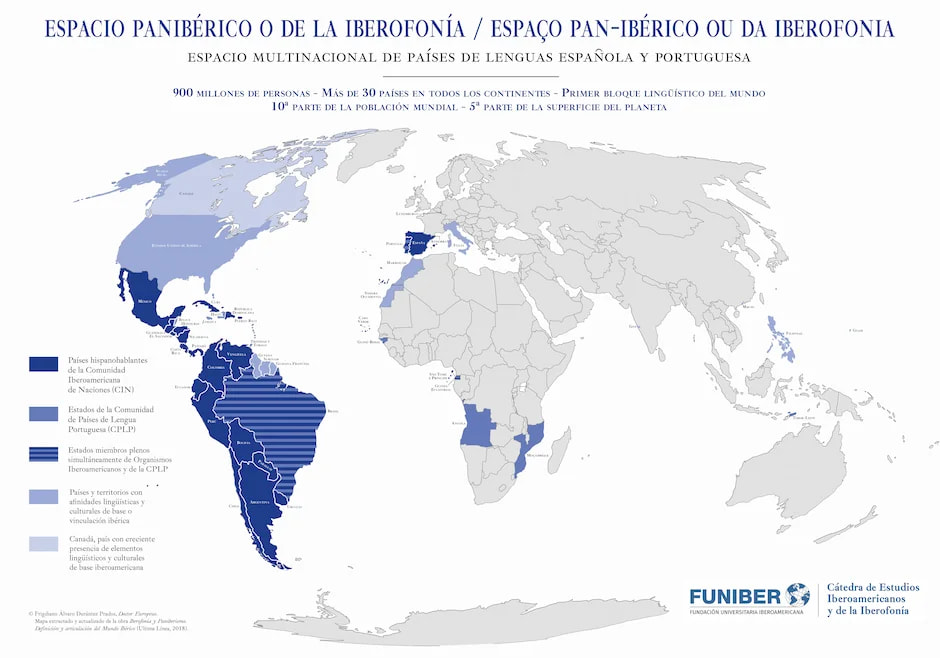
The logic and potential stemming from the substantive affinity between the two main Iberian languages, Spanish and Portuguese, together with numerous and profound cultural, historical, geopolitical, and cooperative elements, form the basis of the multinational space comprising Spanish- and Portuguese-speaking countries—the so-called Pan-Iberian or Iberophone Space‒, which represents a step beyond the Ibero-American Community of Nations and largely corresponds to the sum of that community and the Community of Portuguese Language Countries. This space is a multinational group that currently comprises more than 900 million people and some 30 countries across all continents—America, Africa, Europe, Asia, and Oceania—constituting the world’s largest linguistic bloc and accounting for more than one-tenth of the global population, while representing, on a weighted basis, one-fifth of the Earth’s land area.
The study and research of this emerging multinational Iberian-speaker region—and the training of specialists and professionals equipped to address this new reality and its resulting challenges—have become an unavoidable academic imperative in today’s globalized world. The Doctorate in Iberoamerican and Iberophone Studies, sponsored by the FUNIBER Chair of Iberoamerican and Iberophonic Studies, is the first of its kind in the international academic sphere and fills this gap at the highest scientific level.
This program offers a comprehensive and multidisciplinary approach, providing doctoral students with the tools they need to deepen their understanding of the Iberophone space from different perspectives, as well as to analyze global issues, formulate effective policies, and lead international projects in the pan-Iberian and global arenas. With a solid background in history, geopolitics, international relations, and social anthropology, graduates of this academic program will be prepared to excel in various fields on the international field, with a specialization in the Spanish- and Portuguese-speaking worlds and a distinctly universalist perspective.
Accordingly, the pedagogical framework of this academic program is designed to train university professors, researchers, scholars, professionals in the field of international relations, diplomats, and national and international civil servants, as well as other qualified professionals, with the aim of addressing the complex and ever-changing global realities affecting the multinational Iberophone space.
This Doctoral Program allows students to take subjects and conduct doctoral research through a distance-learning program. In this way, doctoral students pursue an advanced graduate-level program tailored to their own pace and work style.
Throughout the program, doctoral students will receive support and guidance from professors and thesis tutors and directors, who will facilitate their learning and academic performance in coursework, research projects, and their thesis, leveraging new technologies.
Structure
| PHASE I: INTRODUCTORY COURSES |
|---|
| Students will take the subjects Methodology of Scientific Research and Research Seminar. These courses will provide students with the necessary knowledge of the main tools of scientific research and the general guidelines for writing a doctoral dissertation. |
| PHASE II: CORE COURSES |
| MANDATORY MODULES |
Students will take the following subjects:
|
| PHASE III: RESEARCH |
| In this phase, students will take the subjects of Research Work I, Research Work II, and Doctoral Thesis Proposal. This phase is completed with the ongoing guidance of the student's thesis director, in order to gather the relevant information needed to complete the work with rigor and efficiency. |
| PHASE IV: DOCTORAL THESIS DEVELOPMENT |
| Finally, during the doctoral thesis development phase, students will take two subjects titled: Doctoral Thesis Development and Doctoral Thesis Dissertation. During this phase, candidates will develop their doctoral thesis and will be required to present and defend the results of their research in a logical and systematic manner before a panel of three doctors who are specialists in the field. |
Educational Methodology
The educational model promotes collaboration and cooperation to enrich the development of individuals, ensuring a process that delivers effective results in terms of the educational investment made versus the return in the form of knowledge and personal and organizational learning. The model incorporates numerous educational and pedagogical innovations that facilitate, enhance, and drive a highly effective learning process. This includes:
- Facilitating contact between students, between teachers, and between both groups.
- Encouraging cooperation and reciprocity: learning as a collective effort.
- Positioning the student as the center of the process in which they actively participate.
- Encouraging continuous communication and interaction between teachers and students.
- Instilling the understanding that education requires time and sustained effort.
- Using motivation as a constant source of encouragement so that students realize that the expected learning outcomes are within their reach.
- Personalizing learning by considering individual differences and diverse learning styles.
Diploma
A doctoral candidate who meets the academic requirements and successfully defends their doctoral thesis in accordance with the regulations of the university offering the doctoral program may be awarded the degree of:
- DOCTOR OF IBEROAMERICAN AND IBEROPHONE STUDIES from the Universidad Internacional Iberoamericana (Mexico).
Curriculum
The Doctorate in Iberoamerican and Iberophone Studies program aims to address current research needs in the political, cultural, social, linguistic, and economic spheres of iberophony. To that end, there is a rigorous curriculum that covers a variety of subjects and methodologies.
The coursework phase of the Doctorate in Iberoamerican and Iberophone Studies is characterized by its collaborative educational model. All subjects include discussion forums that take a reflective and research-oriented approach.
One of the main objectives of these pedagogical initiatives is to take advantage of the opportunities offered by online education to bring together doctoral students from different educational and research traditions, in order to enrich their training process and help them collaboratively delve deeper into their research areas
- (a) Knowledge generation.
(b) Development and use of scientific and professional research methodologies.
(c) Development of solutions through networks of stakeholders.
Phases, Modules, and Subjects
- PHASE I: INTRODUCTORY COURSES
| PHASE I: INTRODUCTORY COURSES | ||
|---|---|---|
| # | SUBJECTS | CREDITS |
| 1 | Methodology of Scientific Research | 5 |
| 2 | Research Seminar – Doctoral Form | 3 |
| TOTAL | 8 | |
- PHASE II: CORE COURSES
| PHASE II: CORE COURSES | ||
|---|---|---|
| # | MANDATORY MODULES | CREDITS |
| 1 | History, Geopolitics, and Globalization | 5 |
| 2 | Multinational Communities | 5 |
| 3 | Identity-Defining Elements of the Pan-Iberian Space | 5 |
| 4 | Conceptual Foundations and Historical Evolution of Pan-Iberian Thought | 5 |
| 5 | The Iberian World in the Late Modern Period and Today | 4 |
| 6 | The Ibero-American Community of Nations (CIN) and the Community of Portuguese-Speaking Countries (CPLP) | 4 |
| 7 | Convergence and Coordination of the Pan-Iberian or Iberophone Space | 4 |
| 8 | Pan-Iberian Universalism in the Face of the Current Model of Globalization | 2 |
| TOTAL | 34 | |
- PHASE III: RESEARCH
| PHASE III: RESEARCH | ||
|---|---|---|
| # | SUBJECTS | CREDITS |
| 1 | Research Work I | 10 |
| 2 | Research Work II | 10 |
| 3 | Doctoral Thesis Proposal | 18 |
| TOTAL | 38 | |
- PHASE IV: DOCTORAL THESIS DEVELOPMENT
| PHASE IV: DOCTORAL THESIS DEVELOPMENT | ||
|---|---|---|
| # | SUBJECTS | CREDITS |
| 1 | Doctoral Thesis Development | 20 |
| 2 | Doctoral Thesis Dissertation | 15 |
| TOTAL | 35 | |
Lines of Research
The following is a list of potential research topics related to the doctoral program
| DOCTORATE IN IBEROAMERICAN AND IBEROPHONE STUDIES | |
|---|---|
| # | LÍNEAS DE INVESTIGACIÓN |
| 1 | The Historical Development of the Pan-Iberian Space and Its Geopolitical Evolution. |
| 2 | Iberophony as an Actor in the Contemporary International System. |
| 3 | Relations Between Latin America, the Iberian Peninsula, and Portuguese-Speaking Africa. |
| 4 | Regional Integration in the Ibero-American Context: Challenges and Opportunities. |
| 5 | A Comparative Analysis of Foreign Policies in Iberophone Countries. |
| 6 | The Role of the Spanish and Portuguese Languages as Instruments of Soft Power. |
| 7 | Cultural Identity and Diversity in Ibero-American Communities. |
| 8 | South-South Cooperation in the Ibero-American Space. |
| 9 | The Ibero-American Community of Nations and Its Political and Social Impact. |
| 10 | The Community of Portuguese-Speaking Countries as a Platform for International Cooperation. |
| 11 | Globalization and the Reconfiguration of the Iberophone Space. |
| 12 | Migration and Diasporas in the Ibero-American World. |
| 13 | Multilevel Governance in the Pan-Iberian Space. |
| 14 | Sustainable Development in Iberophone Countries. |
| 15 | Ibero-American Cultural Diplomacy and Educational Cooperation. |
| 16 | Economic Transformations in the Contemporary Iberian World. |
| 17 | Pan-Iberian Thought: Theoretical Foundations and Historical Evolution. |
| 18 | The Media and the Construction of Ibero-American Narratives. |
| 19 | Human Rights and Democracy in the Iberophone Space. |
| 20 | Geopolitical Challenges of the Pan-Iberian Space in the Face of Global Powers. |
Faculty Leadership
- Dr. Frigdiano Álvaro Durántez Prados. (Madrid, 1969). Doctor Europeus and recipient of the Special Doctoral Award in Political Science from the Universidad Complutense de Madrid. He is a pioneer in the contemporary movement of Pan-Iberism or Iberophony, a geopolitical and cooperative theory and trend that advocates for the definition and articulation of a multinational space comprising countries and peoples of Spanish and Portuguese-speaking nations across all continents. In 1995, he founded the Spanish Pan-Iberian Iberophony Society. Dr. Álvaro has an extensive academic and professional background. He has served on working groups at the Elcano Royal Institute for International and Strategic Studies (RIE) and at the Spanish Institute for Strategic Studies of the Ministry of Defense (IIEE). He is a corresponding member of the Royal Academy of Jurisprudence and Legislation of Spain, a full and honorary member of the Academy of Diplomacy, an associate member of the Equatorial Guinean Academy of the Spanish Language, and a professor at the Universidad Europea del Atlántico (Santander, Spain). He is also director of the FUNIBER Chair of Iberoamerican and Iberophonic Studies, an academic framework that is interdisciplinary, inter-university, intercontinental, and bilingual in Spanish and Portuguese. This chair of Pan-Iberian studies is also the first of its kind to focus on the global Pan-Iberian sphere of the Spanish and Portuguese languages. Durántez has served as an advisor in the Directorate General for Foreign Policy on Ibero-America at Spain’s Ministry of Foreign Affairs and Cooperation, as well as in the Office of the Ibero-American General Secretariat (SEGIB), an intergovernmental organization that supports the Ibero-American Summits of Heads of State and Government. In 2009, he was appointed advisory member for Studies and Reports at the Office of His Majesty the King of Spain, a constitutional body that supports the Head of State; and since February 2022, he has served as director of Institutional Relations at the Iberoamerican University Foundation (FUNIBER).
Professors and Authors
- Dr. Luis Dzul López. Doctor of Project Engineering: Environment, Quality, and Prevention from the Universidad Politécnica de Cataluña, Spain. Civil engineer and expert in international cooperation projects. Rector of the Universidad Internacional Iberoamericana (Mexico).
- Fundación Gustavo Bueno. Affiliated Center of the Universidad Europea del Atlántico, Spain.
- Dr. Rubén Calderón Iglesias. Doctor of Economics of Education from the Universidad Antonio de Nebrija, Spain. Rector of the Universidad Europea del Atlántico, Spain.
- Dr. Frigdiano Álvaro Durántez Prados. Doctor Europeus and recipient of the Special Doctoral Award in Political Science; Master’s degree in International Studies; Master’s degree in Advanced Ibero-American Studies; and Bachelor's Degree in Law from the Universidad Complutense de Madrid.
- Dr. Eduardo García Villena. Doctor of Project Engineering: Environment, Quality, and Prevention from the Universidad Politécnica de Cataluña, Spain. Academic Director of the Environment Department at the Universidad Internacional Iberoamericana.
- Dra. Nancy Elena Ferreira Gomes. Doctor of International Relations from the Universidade Nova de Lisboa, Portugal. Master’s degree in International Relations from the Universidade Técnica de Lisboa, Portugal. Bachelor's degree in International Studies from the Universidad Central de Venezuela.
- Dr. José Antonio Crespo-Francés y Valero. Doctor of Art and Humanities from the Universidad de Navarra, Spain. Master's degree in Native American Studies from the Universidad Complutense de Madrid, Spain. Colonel in the Infantry, graduate of the Higher School of the General Corps of Arms, Spain.
- Dr. Pablo González Velasco. Doctor of Social Sciences from the Universidad de Salamanca, Spain. Master's degree in Business Journalism from the Universidad Rey Juan Carlos, Spain. Bachelor's Degree in Economics from the Universidad Autónoma de Madrid, Spain.
- Dr. Manuel Hernández Ruigómez. Doctor of American History from the Universidad Complutense de Madrid. Holds a Diploma in Advanced International Studies from the Society for International Studies. And a diploma in European Communities from the Diplomatic Academy. Madrid. Bachelor's Degree in Philosophy and Literature from the Universidad Complutense de Madrid.
- Dr. Eduardo René Silva Alvarado. Doctor of Projects from the Universidad Internacional Iberoamericana de México. Master's Degree in International Business Management from the Universidad Autónoma de Barcelona. Lawyer and Notary Public from the Universidad Rafael Landívar (in good standing with the Bar). Postgraduate degree in Commercial Law from the Guatemalan Institute of Commercial Law.
- Dr. Roberto M. Álvarez. Doctor of Project Engineering from the Universitat Politècnica de Catalunya, Spain. Professor at the Universidad de Buenos Aires, Argentina. Director of the Iberoamerican University Foundation (FUNIBER) in Argentina.
Scholarships
The Iberoamerican University Foundation (FUNIBER) has created a “Doctoral Scholarships” program, aimed at individuals with an excellent academic record. Other foundations, institutions, and universities have joined this scholarship program. It is aimed at both university faculty (with the goal of increasing the percentage of doctorate holders at universities) and professionals in the business world and public administration (with the aim of contributing to the creation of R&D&I departments and fostering a spirit of innovation).